You've probably seen the term on a product page and kept scrolling. Smyth-sewn. It sounds technical, like something that belongs in a spec sheet, not a decision that affects how a Bible actually holds up.
But it's one of the few details that decides whether a Bible survives years of daily use — or starts falling apart in two.
The short answer
Smyth-sewn means the pages are grouped into small sections, called signatures, and each one is sewn through the fold with thread. The signatures are then sewn to each other along the spine.
The result: a book that opens flat, stays open on its own, and holds its pages under real, repeated use.
The alternative — glued binding — holds pages together with adhesive along a single spine edge. No stitching. Just glue.
Why it matters more for a Bible than most books
A novel gets opened once, read straight through, closed, and shelved.
A Bible gets opened thousands of times. Same passages, over and over. Held open flat on a desk. Cracked open one-handed in a truck. Left open overnight next to a chair.
Glued bindings weren't built for that kind of repetition. Over time, the adhesive dries out, pages loosen, and sections start to separate — especially at the passages you return to most.
Smyth-sewn binding is built for exactly that kind of return use. The stitching doesn't rely on adhesive holding forever. It holds because the pages are physically bound together, section by section.
Smyth-sewn vs. glued, side by side
|
|
Smyth-sewn |
Glued |
|---|---|---|
|
How it's built |
Signatures sewn individually, then sewn together |
Pages glued along one spine edge |
|
Opens flat |
Yes |
Rarely |
|
Holds up to daily use |
Built for it |
Wears with repeated opening |
|
Repairable |
Yes — can be re-sewn |
Limited — notch-cut and re-bound with hemp cord |
|
Feel over time |
Loosens slightly, stays intact |
Stiffens, then cracks or sheds pages |
Where this comes from
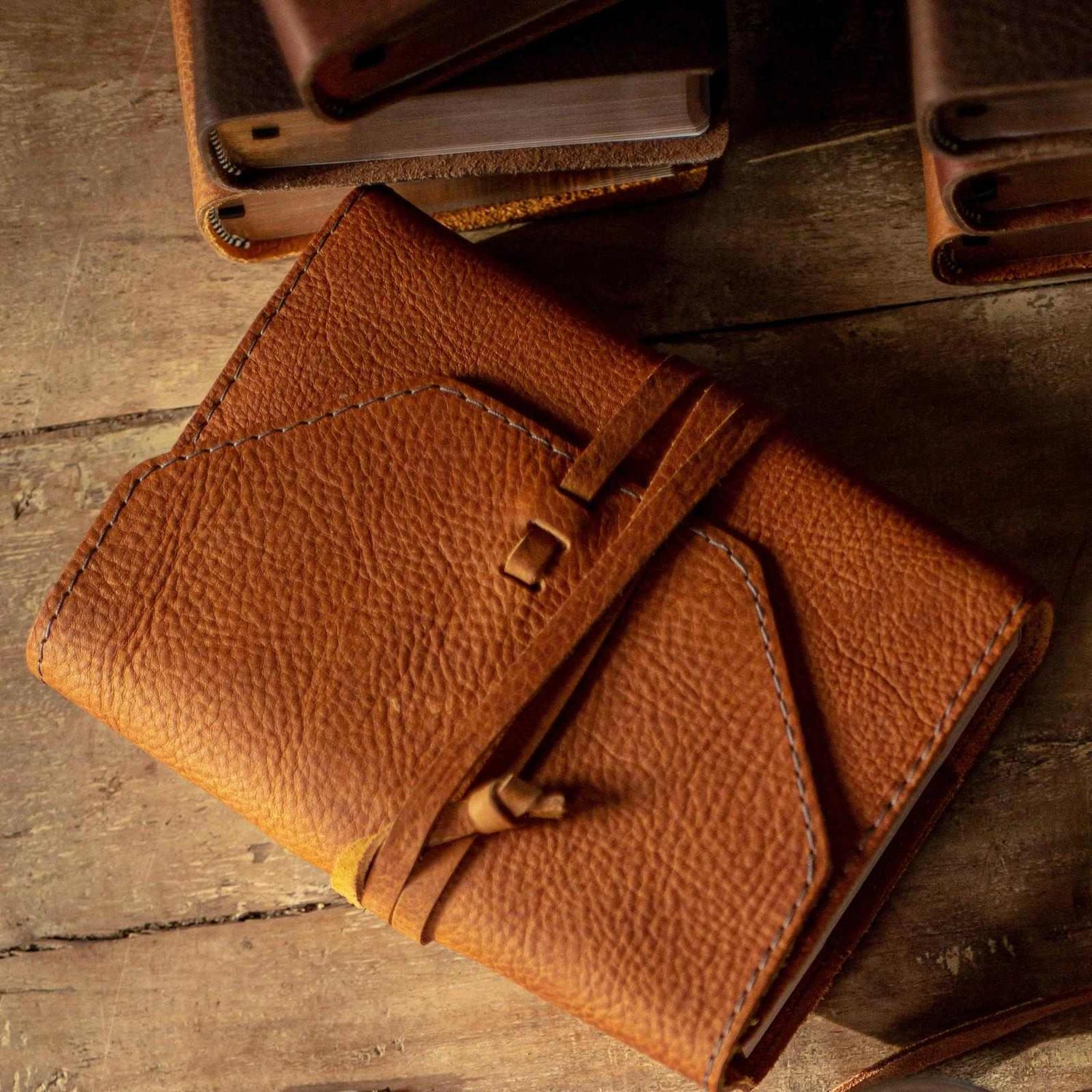
Every Smyth-sewn Bible we offer is sourced already bound this way — it's a standard we require, not something added after the fact. What we build is the leather that protects it: full-grain covers, handbound or wrapped, made to match the binding's durability.
If a Bible ever needs attention down the road, our restoration service can re-sew a Smyth-sewn binding to bring it back to daily use. Glued Bibles that come through restoration get notch-cut and re-bound with hemp cord — a different repair, because they were never sewn to begin with.
A question worth asking
If you're comparing two Bibles and one says Smyth-sewn and the other doesn't say anything at all — that's usually your answer. Most glued Bibles don't advertise it, because there's not much to say.
Common questions
Does Smyth-sewn cost more? Sometimes, because it takes more labor to produce. But the cost shows up as fewer replacements over the years, not just a higher price today.
Can a Smyth-sewn Bible still fall apart? Any book can wear with enough time and use. The difference is what happens next — a Smyth-sewn binding can be re-sewn and brought back to daily use, where a glued binding has far fewer repair options.
Do all Narrow Gate Bibles use Smyth-sewn binding? Yes. Every Handbound and Wrapped Thinline, and every Large Print Bible, is built on a Smyth-sewn text block.
How do I know if a Bible I already own is Smyth-sewn? Open it flat to the middle and look at the spine. If you can see small groups of pages stitched together in sections, it's Smyth-sewn. If the spine is a single smooth strip with no visible stitching, it's glued.
Every Handbound and Wrapped Thinline Bible from Narrow Gate is built on a Smyth-sewn text block, wrapped in full-grain leather, and backed by a 5-year warranty.